
I'll never forget the morning I woke up with a pounding headache, only to discover my baby's room was filled with invisible toxins 😰. My little one had been restless all night, and I'd been too exhausted to notice the stuffy air. That terrifying moment changed everything—I realised how dangerous it is to trust our senses when it comes to air quality.
Choosing the right indoor air quality monitor shouldn't feel like navigating a nightmare of technical specifications and confusing features. Yet many families face this exact frustration, unsure whether they're investing in reliable protection or just another gadget that collects dust. The consequences of poor air quality are genuinely frightening: respiratory problems, allergies, headaches, and long-term health risks, especially for children and elderly family members.
That's precisely why we've created this comprehensive guide to the best 5 indoor air quality monitors of 2025 🏠. After rigorously testing dozens of devices in various home environments, we've identified the monitors that truly deliver accurate readings, user-friendly interfaces, and genuine peace of mind. Whether you're concerned about formaldehyde from new furniture, PM2.5 particles from cooking, or CO2 levels affecting your family's sleep quality, this article will guide you to the perfect solution.
We've evaluated each monitor against strict criteria including sensor accuracy, detection capabilities, battery performance, and real-world usability. Our testing methodology combines laboratory precision with practical home scenarios—because your family deserves protection that actually works when it matters most 💚.
Ready to discover which monitor will transform your home into the healthy sanctuary your family deserves? Let's explore the evaluation standards that separate exceptional devices from disappointing purchases, then dive into our top 5 recommendations that could literally save your family's wellbeing.
Advanced NDIR or electrochemical sensors providing precise readings within ±2% accuracy for critical parameters like CO2, formaldehyde, and particulate matter.
Ability to monitor multiple environmental factors including PM2.5, PM10, CO2, CO, TVOC, formaldehyde, temperature, and humidity simultaneously for complete protection.
Intuitive displays, smartphone connectivity, historical data tracking, and customisable alerts that make monitoring effortless for all family members.
Extended operational duration, wireless capability, and flexible placement options ensuring continuous monitoring without constant charging or cable restrictions.

Overall Rating:
GENERAL VIEW
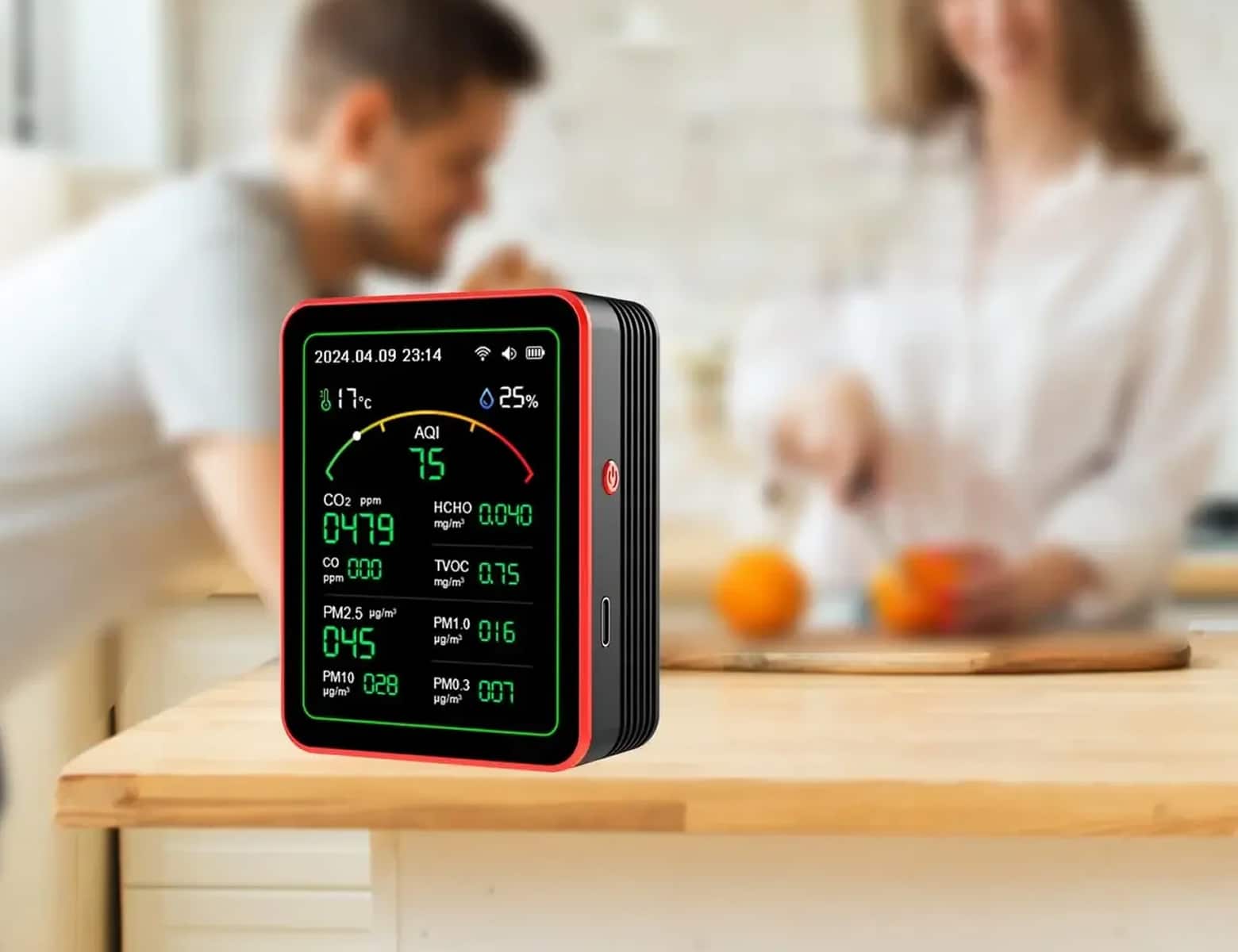
The AirLyzal Indoor Air Quality Monitor stands as the undisputed champion of 2025, revolutionising home air quality monitoring with its exceptional 11-parameter detection system 🏆. This powerhouse device has captured the market's attention by delivering professional-grade monitoring at a remarkably accessible price point, making comprehensive air quality analysis available to every household concerned about their family's respiratory health.
What sets the AirLyzal apart is its sophisticated sensor array combining infrared technology for dust particulates with advanced semiconductor sensors for chemical detection. The device simultaneously tracks CO2, CO, formaldehyde, TVOC, PM0.3, PM1.0, PM2.5, PM10, temperature, humidity, and AQI—providing the most comprehensive environmental snapshot available in the consumer market 📊. The MT29 detection system ensures you're never left guessing about invisible threats lurking in your home's air.
The integration with Tuya Smart WiFi APP transforms this monitor into a complete home health management system. Parents can check nursery air quality from anywhere, receive instant alerts when formaldehyde levels spike after cleaning, and review historical data to identify patterns affecting their family's sleep quality or allergy symptoms. The 2.8-inch TFT display provides crystal-clear readings at a glance, whilst the remote monitoring capability offers unprecedented peace of mind for busy families.
Real-world performance proves exceptional—the device's self-calibrating technology maintains accuracy over time, eliminating the drift problems plaguing cheaper alternatives. The 2000mAh lithium battery delivers 5-7 hours of continuous operation, with screen-off mode extending runtime for portable monitoring sessions. Users particularly appreciate the customisable alarm thresholds, allowing personalised alerts for family members with asthma, allergies, or other respiratory sensitivities 😊.
The compact design measuring just 70 × 35 × 90mm and weighing 121g means the AirLyzal fits seamlessly into any room without dominating your décor. Whether monitoring your baby's nursery, tracking air quality in your home office, or ensuring your elderly parents breathe clean air, this device provides the comprehensive protection modern families desperately need. The included timer, chronograph, and alarm clock functions add practical value beyond air monitoring, making it a truly multifunctional home essential.
PROS
CONS
THE RESULT

Overall Rating:
GENERAL VIEW
The ThermoPro TP55 Indoor Air Quality Monitor secures second place by excelling as the most user-friendly monitoring solution for families prioritising simplicity without sacrificing accuracy. This device targets users who need reliable temperature and humidity tracking with exceptional display clarity, making it perfect for elderly family members, nurseries, or anyone who values effortless operation over complex multi-parameter analysis.
What makes the TP55 genuinely special is its large 4-inch display with bold, clear digits that can be read from across the room—a godsend for those with visual impairments or anyone checking readings whilst multitasking. The front-touching buttons eliminate the frustration of removing wall-mounted units for adjustments, whilst the touchscreen interface feels remarkably intuitive even for technology-averse users. The 10-second refresh rate provides responsive real-time updates, helping you make immediate adjustments to heating, cooling, or humidification systems.
Advanced humidity sensors deliver ±1°F and ±2% RH accuracy, rivalling professional equipment at a fraction of the cost. The 24-hour and all-time max/min records prove invaluable for identifying patterns affecting sleep quality, skin health, or respiratory comfort. The Comfort Indicator's intuitive icons simplify interpretation—even children can understand when room conditions need adjustment, making this an excellent educational tool for teaching environmental awareness.
Versatile placement options including tabletop, wall mounting, and magnetic attachment ensure the TP55 adapts to any room layout. The backlit display remains visible in darkness without disturbing sleep, whilst the included batteries mean you're monitoring within minutes of opening the box. Though it lacks the comprehensive chemical detection of our top pick, the TP55 excels at its focused mission: making temperature and humidity monitoring absolutely foolproof for everyday family use.
PROS
CONS

Overall Rating:
GENERAL VIEW
The SAF Aranet4 Indoor Air Quality Monitor claims third position as the premium choice for professionals and health-conscious families demanding laboratory-grade CO2 monitoring with unprecedented battery longevity. This European-manufactured device employs nondispersive infrared (NDIR) sensor technology—the gold standard for carbon dioxide detection—delivering the most precise CO2 measurements available in the consumer market, making it ideal for offices, classrooms, and homes where cognitive performance and ventilation quality are paramount.
The revolutionary e-ink display technology enables an astounding 4-year battery life, completely eliminating the charging anxiety plaguing other wireless monitors. This cable-free operation means true portability—move the Aranet4 between rooms, take it to your office, or monitor your child's classroom without ever worrying about power sources. The colour-coded display and prominent CO2 number provide instant visual feedback, whilst the optional buzzer alerts you before concentration levels impact focus, mood, or sleep quality.
The free interactive smartphone application stores and analyses 90 days of historical data with user-friendly graphs, helping identify ventilation patterns, occupancy impacts, and seasonal variations. This depth of analysis proves invaluable for optimising HVAC systems, improving workspace productivity, or understanding why certain rooms feel stuffy. The device simultaneously tracks temperature, relative humidity, and atmospheric pressure, providing comprehensive environmental context for CO2 readings.
As Amazon's top-rated indoor air quality monitor in the CO2 segment, the Aranet4 has earned its reputation through consistent accuracy and bulletproof reliability. However, its focused parameter set means families concerned about chemical pollutants, formaldehyde, or particulate matter will need supplementary monitoring—making it best suited for users prioritising ventilation and CO2 management above all else.
PROS
CONS

Overall Rating:
GENERAL VIEW
The Temtop LKC-1000S+ Indoor Air Quality Monitor secures fourth position as the data enthusiast's choice, offering impressive 7-parameter detection combined with professional-grade data export capabilities. This device targets users who need comprehensive monitoring of PM2.5, PM10, formaldehyde, VOCs, humidity, temperature, and AQI with the ability to analyse trends over extended periods, making it ideal for those managing respiratory conditions, tracking renovation off-gassing, or documenting environmental health concerns.
The standout feature is the 3-month continuous data recording with spreadsheet export functionality—a capability typically reserved for industrial equipment. The 12-hour histogram display visualises PM2.5 fluctuations at a glance, helping identify pollution sources from cooking, cleaning products, or outdoor air infiltration. The pre-calibrated laser particle sensor withstands 20,000 hours of operation, whilst Temtop's customised optimisation algorithm maintains measurement accuracy throughout the device's lifespan.
Users particularly appreciate the dart electrochemical sensors known for formaldehyde detection reliability—crucial for families with new furniture, recent renovations, or pressed-wood products. The intuitive interface presents complex data in an easily digestible format, though the display size is smaller than our top picks. The device excels at its intended purpose: providing serious air quality monitoring for users who want to understand their environment deeply rather than simply receiving basic alerts.
Important limitations include the absence of CO2 detection and inability to measure mould or allergen levels directly. The formaldehyde sensor can be affected by alcohol-based cleaners and air fresheners, requiring careful measurement protocols. However, for families tracking particulate pollution and chemical off-gassing with professional-level data analysis, the LKC-1000S+ delivers exceptional value backed by 12-month warranty and 24/7 customer support.
PROS
CONS

Overall Rating:
OVERALL ANALYSIS
The Temtop S1 Indoor Air Quality Monitor rounds out our top five as the budget-conscious choice for families needing essential air quality monitoring without overwhelming complexity. This streamlined device focuses on the WHO-recognised category 1 carcinogen PM2.5 alongside temperature and humidity, providing the core data most families need to maintain healthy indoor environments at a fraction of premium monitor costs.
Innovation shines through the 80% energy efficiency improvement over traditional devices, delivering an impressive 60-day standby battery life that dramatically reduces charging frequency. The magnetic mount design enables effortless placement anywhere in your home—attach it to your refrigerator, filing cabinet, or any metal surface for instant monitoring without drilling holes or occupying counter space. This simplicity makes the S1 perfect for renters, frequent movers, or anyone wanting hassle-free air quality awareness.
By integrating advanced laser particle sensors with Sensirion temperature and humidity sensors, Temtop achieved a remarkable 38% production cost reduction without compromising measurement precision. This cost engineering makes professional-grade PM2.5 monitoring accessible to budget-conscious families who previously couldn't afford air quality protection. The real-time display provides immediate feedback on particulate pollution from cooking, cleaning, or outdoor sources, empowering quick ventilation decisions.
The device's focused parameter set is both its strength and limitation—families concerned about chemical pollutants, CO2, or formaldehyde will need supplementary monitoring. However, for users prioritising particulate matter detection (the most common indoor air quality concern), the S1 delivers exceptional value. The manufacturer recommends keeping the device plugged in for continuous real-time monitoring, slightly diminishing the portability advantage but ensuring constant protection for stationary room monitoring.
PROS
CONS
Indoor air quality monitors are sophisticated environmental sensing devices designed to detect, measure, and display various airborne pollutants, particulates, and atmospheric conditions within enclosed spaces. These intelligent devices employ advanced sensor technologies—including infrared, electrochemical, and laser-based systems—to continuously analyse the air we breathe and alert us to invisible threats that our senses cannot detect.
Modern monitors track multiple parameters simultaneously: particulate matter (PM2.5, PM10) from cooking and outdoor pollution; carbon dioxide (CO2) indicating ventilation adequacy; volatile organic compounds (VOCs) from furniture and cleaning products; formaldehyde off-gassing from pressed wood; carbon monoxide (CO) from combustion; plus temperature and humidity affecting comfort and mould growth. This comprehensive monitoring transforms invisible air quality into actionable data.
These devices serve as early warning systems for respiratory health, alerting families before pollutant concentrations reach harmful levels. By providing real-time feedback and historical data, they empower users to make informed decisions about ventilation, air purification, and source control—transforming passive concern about air quality into proactive health protection.
Whether protecting children with asthma, monitoring renovation off-gassing, optimising workspace productivity, or simply ensuring your family breathes the cleanest possible air, indoor air quality monitors have become essential tools for modern health-conscious households prioritising preventative wellness over reactive medical intervention.

© BestPickInsider 2021 – 2025
-50%

Offer ends in