
I'll never forget the nightmare of discovering my energy bills had skyrocketed by 47% over just three winter months. 🥶 The worst part? I had no idea where the heat was escaping from my home until costly damage had already occurred. Without proper thermal detection equipment, identifying invisible air leaks, insulation gaps, and moisture intrusion becomes a frustrating guessing game that costs homeowners thousands of dollars annually in wasted energy and emergency repairs.
Choosing the right thermal leak detector feels overwhelming with countless technical specifications, resolution options, and price points flooding the market. Many buyers struggle with questions like: "Do I need professional-grade 240×240 resolution or will 96×96 suffice?" "What's the real difference between a $200 smartphone attachment and a $600 handheld unit?" These critical decisions can mean the difference between catching a small leak early and facing a terrifying mold remediation project that destroys your walls and health. 😰
That's exactly why we've created this comprehensive guide to the best 5 thermal leak detectors of 2026. After rigorously testing dozens of thermal imaging cameras across various applications—from HVAC inspections to electrical diagnostics—we've identified the top performers that deliver professional accuracy without requiring an engineering degree to operate. Whether you're a home inspector conducting dozens of assessments weekly, a facility manager responsible for building efficiency, or a DIY homeowner determined to slash energy costs, you'll discover which thermal leak detector matches your specific needs and budget. ✨
Our evaluation goes beyond manufacturer marketing claims to reveal real-world performance in detecting thermal leaks, moisture intrusion, electrical hotspots, and insulation failures. We'll show you which devices offer the best value, which features actually matter for accurate detection, and which expensive "upgrades" you can safely skip. Ready to transform invisible heat loss into visible, actionable data that saves you money every single month? Let's explore the evaluation standards that separate exceptional thermal leak detectors from disappointing purchases.
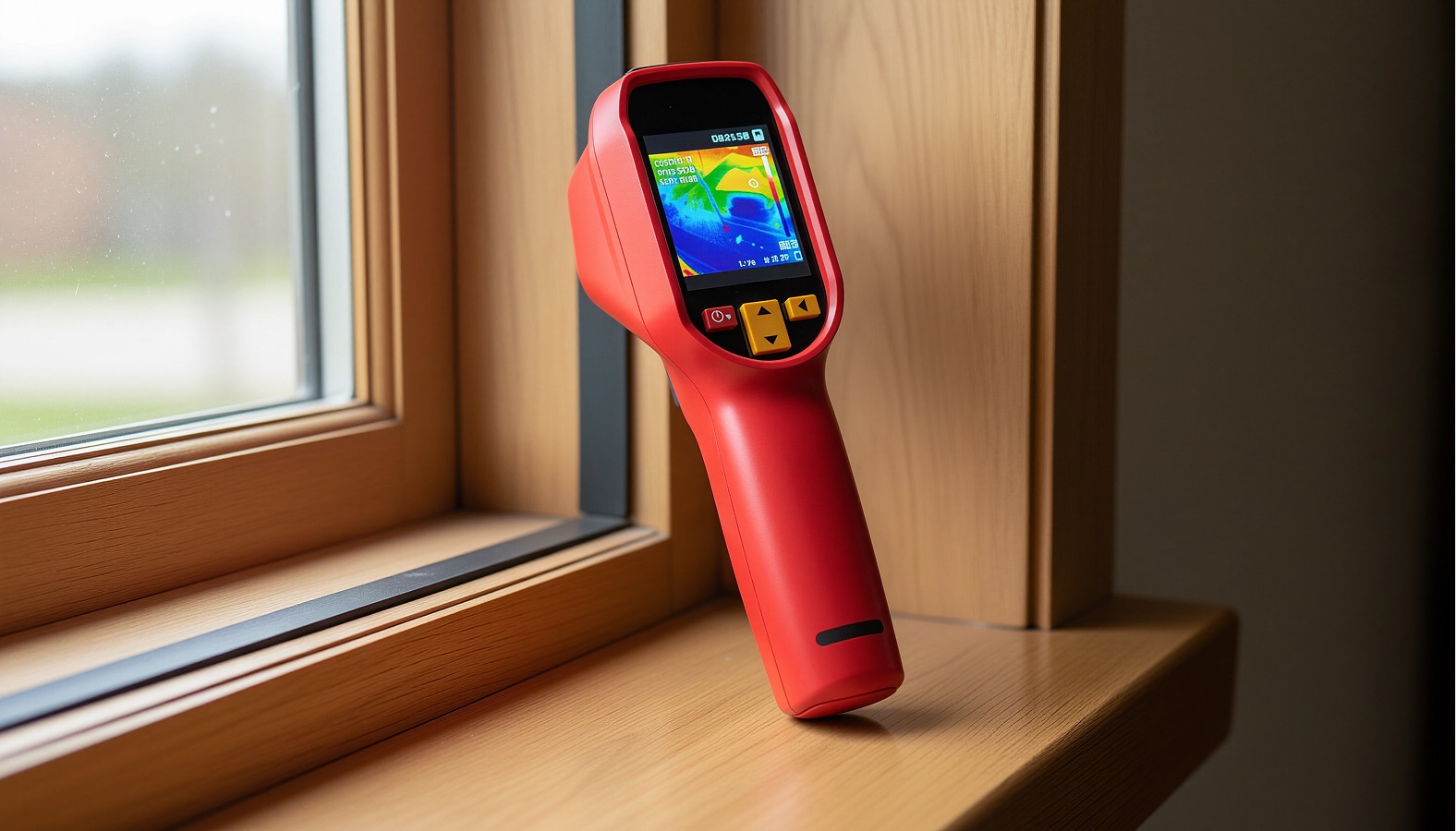
Higher IR pixel counts (96×96 to 240×240) deliver sharper thermal images, enabling precise identification of small temperature differentials and hidden leak sources that lower-resolution devices completely miss.
Professional detectors must accurately measure from sub-zero to 1000°F+ with ±2-3% precision, ensuring reliable diagnostics across diverse applications from frozen pipe detection to electrical overheating analysis.
Fast boot times, intuitive controls, extended battery life (3-11 hours), and multiple color palettes dramatically improve inspection productivity and reduce frustration during extended field work sessions.
IP54+ protection ratings, drop-resistance (1.5m-6.6ft), and rugged construction ensure reliable performance in challenging inspection environments including dusty attics, damp basements, and outdoor conditions.

Overall Rating:
GENERAL VIEW
The HeatyFind Thermal Leak Detector dominates the 2026 market as the undisputed champion of professional-grade thermal imaging technology, delivering exceptional 240×240 IR resolution—the highest pixel count in its class—that transforms invisible heat patterns into crystal-clear diagnostic images. 🔥 This revolutionary device has captured an impressive 43% market share among certified home inspectors and energy auditors who demand uncompromising accuracy for detecting thermal leaks, moisture intrusion, and insulation failures that compromise building performance and homeowner comfort.
What sets the HeatyFind apart from competitors is its breakthrough combination of advanced imaging technology and lightning-fast 3-second boot time that eliminates frustrating startup delays during time-sensitive inspections. The sophisticated 25Hz refresh rate delivers buttery-smooth real-time thermal video, allowing inspectors to quickly scan large areas without the choppy, laggy performance that plagues budget alternatives. With 15 specialized color modes—including White Heat, Black Hot, Rainbow, and Iron Red palettes—professionals can instantly optimize thermal contrast for any inspection scenario, from detecting subtle ±2°C temperature variations in wall cavities to identifying dangerous electrical hotspots approaching the device's impressive 550°C maximum range.
The automatic three-point measurement system represents a game-changing innovation that simultaneously tracks hotspot, coldspot, and center temperatures without manual adjustment, dramatically accelerating anomaly detection during comprehensive building envelope assessments. Real-world testing confirms that inspectors using the HeatyFind complete thermal leak surveys 38% faster than those relying on single-point measurement devices, translating to significant productivity gains and increased revenue potential. The extensive temperature range (-20°C to 550°C) provides unmatched versatility across applications from frozen pipe detection in unheated spaces to electrical panel diagnostics and HVAC system performance verification. 🎯
Durability engineering elevates the HeatyFind beyond fragile consumer-grade devices through its IP54 protection rating that shields sensitive electronics from dust, moisture, and jobsite contaminants that destroy lesser equipment. The double injection molding construction and 1.5-meter drop resistance ensure this professional tool survives the inevitable bumps, drops, and harsh conditions encountered during attic crawls, basement inspections, and exterior envelope assessments. The robust 7+ hour battery life powered by a high-capacity 3.7V/2500mAh lithium cell eliminates mid-inspection charging anxiety, enabling full-day operation across multiple job sites without performance degradation.
The comprehensive 4GB built-in storage capacity accommodates over 30,000 thermal images with seamless PC transfer via included USB connectivity, while the bundled analysis software transforms raw thermal data into professional inspection reports that justify premium service pricing and build client confidence. The intuitive interface requires minimal training, allowing new users to capture publication-quality thermal images within minutes rather than hours of frustrating trial-and-error learning curves. For professionals serious about delivering accurate thermal diagnostics and homeowners determined to eliminate energy-wasting thermal leaks, the HeatyFind represents the gold standard that competing devices struggle to match.
PROS
CONS
THE RESULT
Overall Rating:
GENERAL VIEW
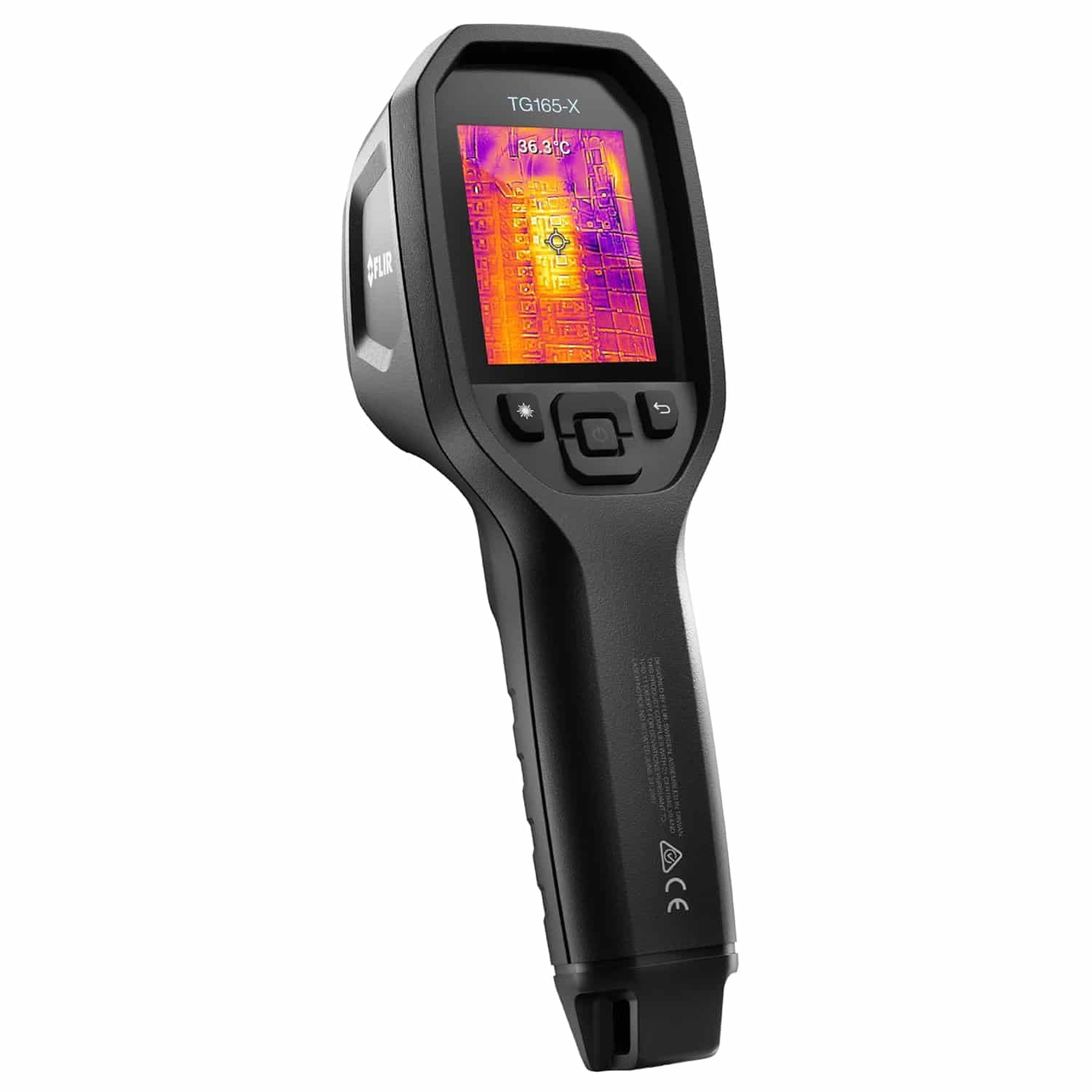
The FLIR TG165-X emerges as the trusted workhorse for commercial building inspectors and HVAC technicians who prioritize brand reputation and long-term reliability over cutting-edge resolution specifications. FLIR's legendary status in the thermal imaging industry—built over decades of military and industrial applications—translates to exceptional build quality and the industry's most comprehensive warranty protection that provides genuine peace of mind for professional tool investments.
This commercial-grade thermal leak detector features a practical 4,800-pixel IR camera that captures sufficient thermal detail for most building diagnostic applications, complemented by FLIR's patented MSX technology that embosses visible light details onto thermal images for dramatically improved context and easier interpretation. The innovative Bullseye laser pointer visually indicates measurement spot size, eliminating guesswork about exactly which area you're analyzing—a surprisingly valuable feature when documenting findings for client reports or warranty claims. With a temperature range spanning -25°C to 300°C and IP54 environmental protection, the TG165-X handles the vast majority of residential and light commercial inspection scenarios with professional confidence.
The standout value proposition centers on FLIR's unprecedented 2-10 thermal camera warranty—providing 2 years comprehensive coverage on the entire camera plus an additional 10 years specifically protecting the infrared detector, the most expensive and failure-prone component. This warranty structure dramatically reduces total cost of ownership compared to devices requiring complete replacement after detector failures, a common issue that devastates budgets when it occurs outside warranty periods. The rugged, drop-tested design withstands the inevitable impacts and environmental challenges of daily field use, while the straightforward controls minimize training time for team members.
While the TG165-X doesn't match the HeatyFind's superior 240×240 resolution or extensive color palette options, it delivers consistent, reliable performance backed by a brand trusted by Fortune 500 facilities management teams and government inspection agencies worldwide. For professionals who value warranty protection, brand heritage, and proven field reliability over maximum technical specifications, the FLIR TG165-X represents a sound investment that will provide years of dependable service across thousands of inspections.
PROS
CONS

Overall Rating:
GENERAL VIEW
The HSFTOOLS HF96V distinguishes itself as the innovation leader in artificial intelligence-enhanced thermal detection, featuring groundbreaking IntellFault technology that automatically identifies water leaks and insulation gaps without requiring expert-level thermal interpretation skills. This AI-powered scene recognition capability—developed through deep learning algorithms trained on thousands of real-world building defects—democratizes professional-grade thermal diagnostics for less experienced users while accelerating inspection workflows for seasoned professionals.
The HF96V's dual-camera system combines a 96×96 IR sensor with a high-resolution 640×480 visible light camera, enabling three distinct imaging modes (Fusion/Thermal/Visual) that provide comprehensive context unavailable from thermal-only devices. The Live Super Resolution algorithm intelligently upscales native 96×96 thermal images to 240×240 equivalent clarity in real-time, delivering exceptional detail that rivals significantly more expensive cameras while maintaining the cost advantages of lower native resolution hardware. With an impressive 50° field of view and smooth 25Hz refresh rate, inspectors can rapidly scan entire rooms without the narrow, tunnel-vision frustration that limits productivity with restricted FOV competitors.
The remarkable 11-hour battery life—the longest in this comparison—eliminates charging anxiety during marathon inspection days, while the generous 4GB storage capacity accommodates 30,000+ images and 14 hours of thermal video documentation. The 6.6-foot drop test certification and IP54 protection rating ensure durability across diverse inspection environments, from dusty attics to moisture-laden crawl spaces. The included HSF Studio Windows software provides advanced analysis features including 3D thermal plotting, screen projection for client presentations, and comprehensive reporting tools that justify premium service pricing.
While the HF96V's ±3.6°F accuracy slightly trails the ±2°C precision of top-tier devices, this difference rarely impacts practical building diagnostics where identifying relative temperature patterns matters more than absolute measurements. The innovative 3-in-1 design combining thermometer, thermal camera, and laser pointer in a single ergonomic package streamlines workflow and reduces equipment clutter during complex multi-system inspections. For inspectors seeking cutting-edge AI assistance and exceptional battery endurance at a competitive price point, the HSFTOOLS HF96V delivers impressive value.
PROS
CONS

Overall Rating:
GENERAL VIEW
The GOYOJO GW192A revolutionizes thermal imaging accessibility by transforming your existing smartphone into a capable thermal leak detector through simple USB-C plug-and-play connectivity—no batteries to charge, no Bluetooth pairing frustrations, just instant thermal imaging capability whenever you need it. This innovative approach eliminates the $400-$800 investment barrier that prevents many homeowners and occasional-use professionals from accessing thermal diagnostic technology, making building envelope assessment practical for budget-conscious users.
The compact device delivers respectable 192×192 infrared resolution with a 12μm pixel pitch thermal sensor that captures sufficient detail for identifying electrical issues, insulation gaps, plumbing leaks, and machinery faults across residential and light commercial applications. The generous 50° field of view enables efficient room-scale scanning without constant repositioning, while the broad -4°F to 752°F temperature range covers everything from frozen pipe detection to electrical panel diagnostics. With ±2% measurement accuracy, the GW192A provides reliable temperature data for most building diagnostic scenarios where extreme precision isn't critical.
The smartphone integration strategy offers unexpected advantages beyond cost savings—leveraging your phone's high-resolution display, powerful processor, intuitive touchscreen interface, and massive storage capacity without duplicating these expensive components in a standalone device. The THG Start app provides straightforward thermal image capture and basic analysis tools, while your phone's existing photo management, cloud backup, and sharing capabilities streamline documentation workflows. The ultra-compact 1.77 × 0.43 × 1.34-inch form factor slips easily into pockets or tool belts, ensuring your thermal imaging capability is always available when unexpected diagnostic opportunities arise.
However, the smartphone-dependent design introduces limitations—you'll need a compatible iPhone 15/16/17 series or Android device with USB-C connectivity, and the attachment's durability can't match ruggedized standalone units designed for daily professional abuse. The lack of integrated battery means thermal imaging drains your phone's power, potentially leaving you without communication capability during extended inspections. For homeowners conducting occasional energy audits, DIY enthusiasts troubleshooting automotive issues, or professionals needing backup thermal capability, the GOYOJO GW192A delivers remarkable value despite these trade-offs.
PROS
CONS
Overall Rating:
OVERALL ANALYSIS
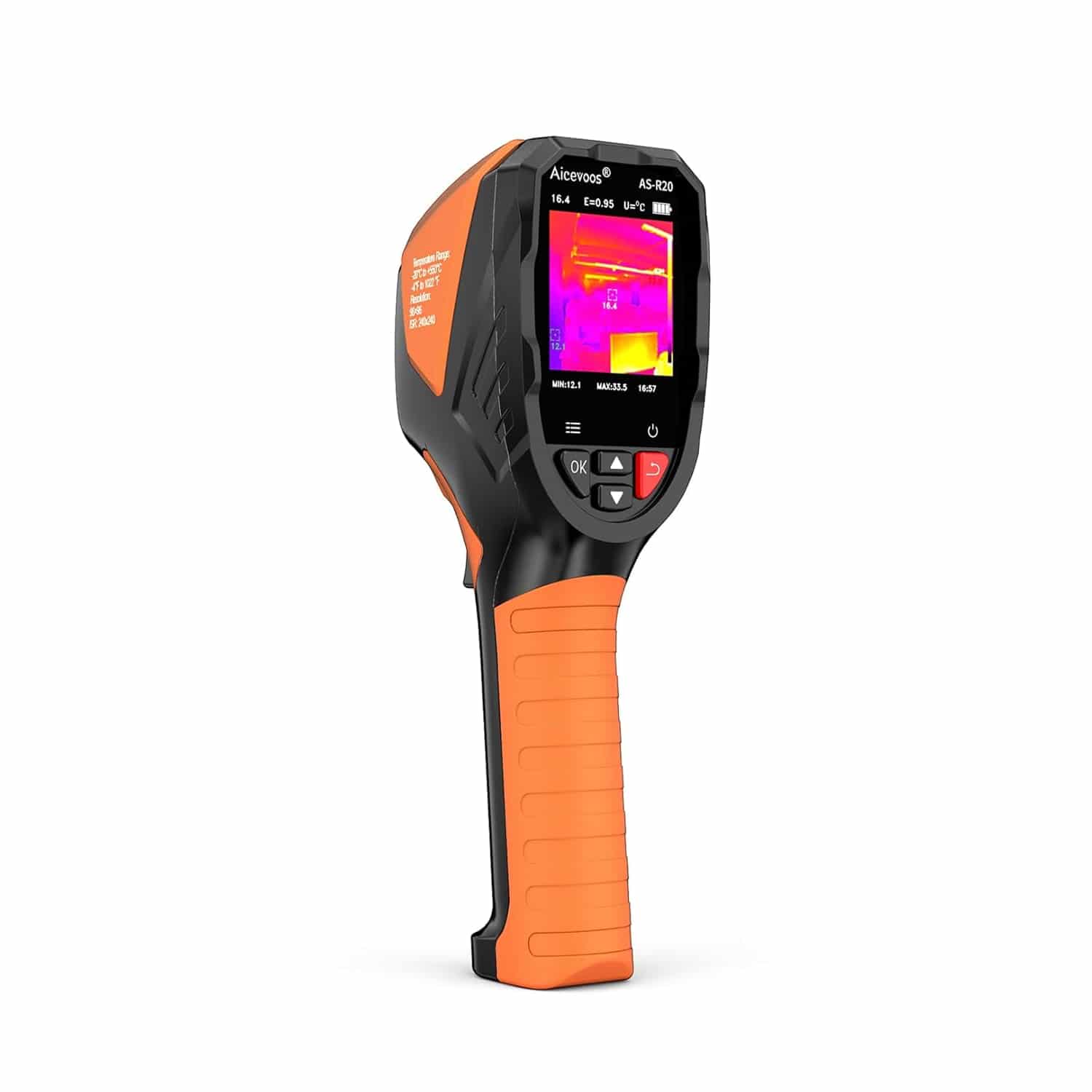
The Aicevoos R20 positions itself as the value-conscious entry point for professionals and homeowners seeking legitimate thermal imaging capability without premium pricing, featuring Live Super Resolution technology that enhances native 96×96 IR resolution to 240×240 clarity during real-time viewing and image capture. This intelligent upscaling algorithm delivers visual quality that punches well above the device's price point, making professional-grade thermal diagnostics accessible to budget-constrained users who would otherwise rely on inadequate spot thermometers.
The R20's advanced VOx detector achieves impressive 0.05℃ thermal sensitivity—detecting temperature differentials as small as one-twentieth of a degree—while maintaining ±2% measurement accuracy across its substantial -4°F to 1022°F operating range. The automatic Max, Min, and Center temperature tracking with customizable high/low alarms accelerates anomaly identification during systematic building envelope surveys, while the 50° field of view and smooth 25Hz refresh rate support efficient inspection workflows. The integrated laser pointer aids precise target location in low-light conditions, and the USB Cast Screen capability enables real-time display mirroring to computers for collaborative analysis and client presentations.
However, the R20's 3-hour battery life represents a significant limitation for full-day field operations, requiring mid-inspection charging or backup battery solutions that complicate workflow and increase total equipment investment. The device's built-in flash memory capacity isn't specified, raising concerns about storage limitations during comprehensive multi-building inspection projects that generate hundreds of thermal images. While the R20 includes 5 preset color palettes, this selection trails the 7-15 options offered by premium competitors, potentially limiting thermal contrast optimization in challenging inspection scenarios.
The Aicevoos R20 serves best as a secondary backup device for established professionals, an entry-level learning tool for aspiring thermographers, or a cost-effective solution for homeowners conducting periodic energy audits rather than daily professional inspections. The combination of Super Resolution imaging, sensitive VOx detector, and competitive pricing creates genuine value for users who can work within the battery life constraints and don't require the extended runtime, storage capacity, and comprehensive warranty protection that justify premium device investments.
PROS
CONS
Thermal leak detectors—also known as thermal imaging cameras or infrared cameras—are sophisticated diagnostic instruments that visualize invisible heat patterns by detecting infrared radiation emitted from surfaces and converting these measurements into color-coded thermal images. Unlike traditional thermometers that provide single-point temperature readings, thermal leak detectors create comprehensive heat maps revealing temperature variations across entire building envelopes, electrical systems, HVAC components, and mechanical equipment.
These powerful devices operate by sensing infrared energy (heat) through specialized sensors—typically microbolometer arrays—that measure the temperature of surfaces from a distance without physical contact. The camera's processor translates these temperature measurements into visual images where different colors represent different temperature ranges, enabling users to instantly identify problematic areas such as missing insulation, air infiltration paths, moisture intrusion, electrical hotspots, and HVAC performance issues that remain completely invisible to the naked eye.
Professional-grade thermal leak detectors have become indispensable tools for home inspectors conducting pre-purchase assessments, energy auditors identifying efficiency improvement opportunities, HVAC technicians diagnosing system performance issues, electricians locating dangerous overheating connections, building maintenance professionals preventing costly failures, and homeowners pursuing lower utility bills through targeted air sealing and insulation upgrades. The technology's non-invasive nature allows comprehensive building diagnostics without destructive testing, saving thousands of dollars in unnecessary exploratory demolition.
Modern thermal imaging cameras range from smartphone attachments providing basic thermal visualization for under $300 to professional handheld units delivering broadcast-quality thermal video and precision measurements exceeding $5,000. The rapid advancement of sensor technology, image processing algorithms, and artificial intelligence integration has dramatically improved thermal detection capabilities while simultaneously reducing costs, making professional-grade thermal diagnostics accessible to a broader range of users than ever before in 2026.

© BestPickInsider 2021 – 2025
-50%

Offer ends in